Self-hosted pipeline for content production and news workflows: ingest web, RSS, and email, parse with plugins, store in SQLite, enrich on demand, then publish RSS, JSON API, and MCP for editorial and distribution tools.
npm install -g rssanyrssany start# open http://127.0.0.1:18473/First run creates ~/.rssany/ with sources.json and config.json
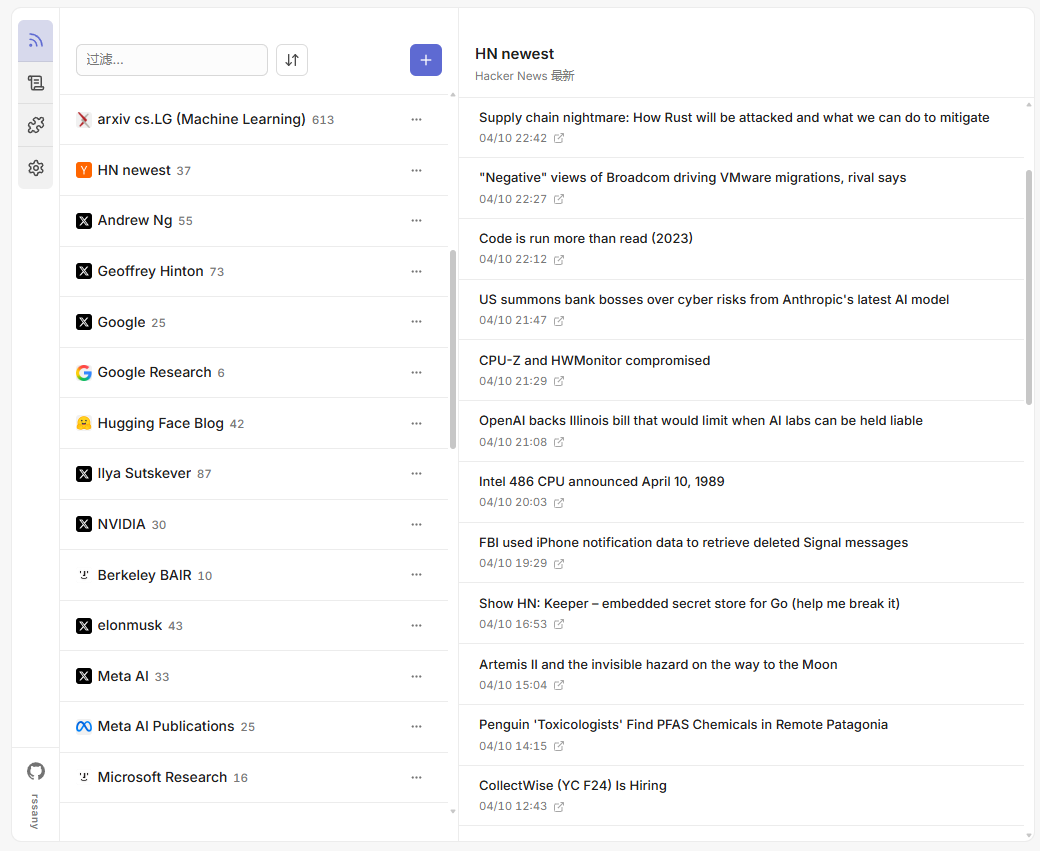
From curated sources through fetch, parse, enrich, and publish — one stack for intelligence gathering and distribution.
Configure web lists, RSS feeds, and IMAP mail in sources.json; the scheduler keeps your news intake on refresh intervals.
Many built-in Site plugins; override or extend under ~/.rssany/plugins with .rssany.js/.ts files.
Tagging, translation, and quality filters live in app/pipeline/, enabled via pipeline.steps in config.
Parsing, extraction, tags, and translation can use an OpenAI-compatible API with rules-first fallbacks.
Generate RSS/Atom/JSON feeds on demand, expose /api/* JSON and MCP for editorial tools, agents, and downstream systems.
Node.js + SQLite under ~/.rssany/, MIT licensed. Install via npm globally or deploy with Docker.
After upsert, each item runs tagging, translation, and more — toggled in config.json.
Scheduler triggers source plugins for list fetch, body extraction, and site login when needed.
Dedupe by guid into SQLite with configurable cache windows and refresh policies.
Per-item chain: tagging, translation, etc., then content and cache updates.
When deliver.url is set, POST { sourceRef, items } JSON after pipeline completes.
Quick answers about RssAny, sources, storage, and installation.
Install in one command, run locally, and own your news and content pipeline.
